
Vote for Change!
by Ben Dunning
“Change” cried the politicians and pundits in the run-up to polling day for the recent UK general election despite this being probably the oldest, glibbest and most obvious cliché of a political slogan. Their use of this word meant it was no coincidence that the political posters that appeared during the election, filling the nations billboards where its visual equivalent. To clarify: a political poster is one that aims to communicate the values, policy or position of a political party and seeks to persuade the electorate to vote for the party it speaks for. What these recent posters made clear to me wasn’t their intended message, whatever that might have been, but instead a deep feeling that if one thing needs to change it is the visual communication associated with politics.
There are, of course, many posters created of a political nature that exist independently of election campaigns raising awareness of specific issues or spreading counter-cultural ideas but they represent something different to what commandeered the nations public spaces at election time.
During the campaigning politicians on the radio, TV and the Internet attempted to give more of an understanding of what they intended by “change” and the policies behind it. The nature of these mediums meant they had time and space to expand upon their positions. Whether they where successful or not at communicating their messages is a moot point. However, what seems obvious to me is that the contemporary political poster, a core element to any campaign, on which this message of change was printed, failed to improve the publics understanding of the issues or their engagement in the political process.
Up Against the Wall: International Poster Design
Russel Bestley & Ian Noble
Rotovison, 2002
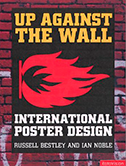
A poster needs to be memorable and deliver its message quickly and clearly, up close and from a distance, to its intended audience. A visually inventive poster design may even offer something extra on subsequent viewings. I believe the recent crop of political posters failed to live up to this description in three ways: Firstly they didn’t communicate effectively because they became lost in the visual landscape. In their book Up Against the Wall,
Bestley and Noble neatly sum-up the problem these types of posters have:
“we are surrounded by visual and typographic information pressing for our attention, which in the main we regard as little more than wall paper.”
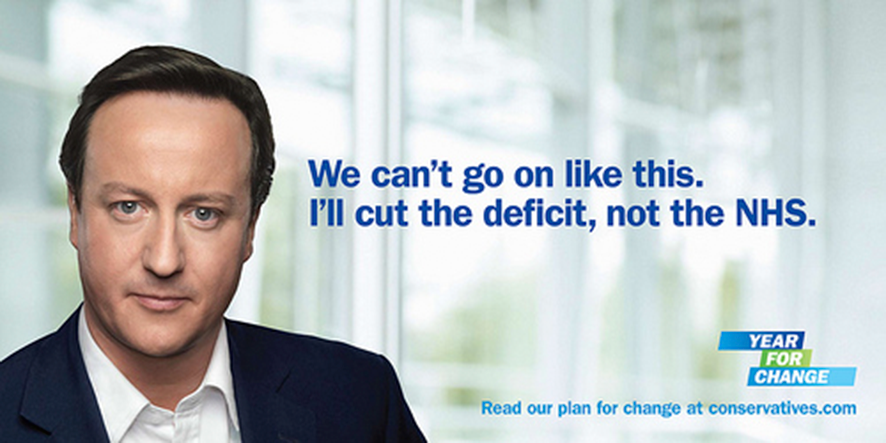
The fog of over-familiarity combined with their bland imagery and messages added to their woes. While both main parties where guilty of publishing work like this the ubiquity of portraits of David Cameron next to some large type, the text of which differed from poster to poster, typified the approach [Fig 1]. Instead, What these compositions where good for was spoofing and satire and they will be remembered for this, not how they helped shape the election.
Fig 1
Secondly they failed to do their part in energising and engaging the electorate, surely a key reason for their existence, as evidenced by the third of registered voters who didn’t turn out in May. Thirdly, but admittedly much more subjectively, they failed as pieces of graphic art to have any visual attraction beyond their message. An article [1] in the Guardian newspaper, in the run up to election, agreed with this position: good political posters have:
“…an appeal as pieces of art, over and above their value as propaganda.”
The aesthetic success of the poster is important because an audience can be drawn to its attractiveness and this in turn may improve the chances of a message being absorbed. Of course a poster for a negative campaign, deliberately dark and ugly in tone, could easily have the effect of driving as much of its audience away as it does persuading them to vote as desired. The striking imagery of the devil eyed New Labour New Danger poster from the 1997 election is memorable, but it is unlikely to be considered effective because of the outcome of that election.
The success of the International Poster and Graphic Arts Festival at Chaumont suggest that poster design is a thriving medium that graphic designers are falling over themselves to be involved in so why is that in this country our political posters are so bad? According to Rick Poynor, in a recent article [2] for Eye about a series of posters designed for the London Design Festival, the medium is an “endangered undertaking in Britain’s Graphic culture” possibly because of a “lack of practice” by our leading designers. If this is indeed the case then something definitely needs to change.
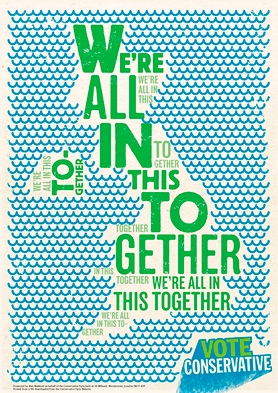
Fig 2
The UK has a great tradition of propaganda posters from the war years and more conventional political posters as evidenced by the collection of work housed in the People’s History Museum in Manchester. This suggests it’s within
the capacity our design culture to produce political work that has longevity and artistic merit. What makes the failure of the poster designs at this election worse is that there where alternatives, away from the mainstream, which started to address their deficiencies but never gained wider public airing.
Against the perceived wisdom that the visual arts are broadly of the left, The Conservative Party found designers to produce a set of posters, first seen around their party conference in the autumn of 2009, that where distinctive graphical images which attempted to tackle the need to symbolise ideas as well as slogans. In terms of their visual appeal they are far ahead of what the public saw several months later in the heart of the campaigning: photoshopped photography and blunt typographic approaches. These designs are by their nature harder to spoof and satirise well and would have stood out against the sterile offerings of the other main political parties.

Fig 3
Their major flaw, which was not within the designers control, is that some of the concepts and slogans where vague enough to not make it easy to associate them with the Conservative Party. This may, of course be intended. The message of one of the stronger designs “We Are All in this Together” [Fig 2] delivers a concept that would sit comfortably with left wing political ideals, as does “People Power” [Fig 3]. Without the appeal to “Vote Conservative” attached to the bottom of these posters we are left with their colouring to help with association, but the frequent use of green might suggest affiliation elsewhere.
Several posters in support of the Labour party where created by a variety of high profile artists for the website makeamark.org.uk. What’s notable about the contributors to this site is that graphic designers, or at least those who work in graphic design fields are conspicuous in their absence. Fraser Muggeridge, whose contribution (Fig) is an interesting typographical experiment that would be likely to have little wider public appeal, and Ian Anderson, whose piece is a clear piece of negative campaigning that is simultaneously obvious, humorous and striking, are the only notable flag bearers.
The unfortunate effect of this lack of graphic designers is that in many cases the posters are only fractionally better than the mainstream efforts in terms of their likely effectiveness. A case in point would be Jamie Shovlins piece. It looks too similar to the mainstream efforts and most likely would disappear in the noise too, while its satirical message fails to hit the spot as well as some of the spoofs. The more successful efforts represented by Liam Gillick’s several contributions use strong clear type to, in his words, “…remind voters what the party (Labour) stands for, and to encourage them to vote.” [3] However far from reality this statement seems in recent times, it’s hard to disagree with this approach.
Fig 4
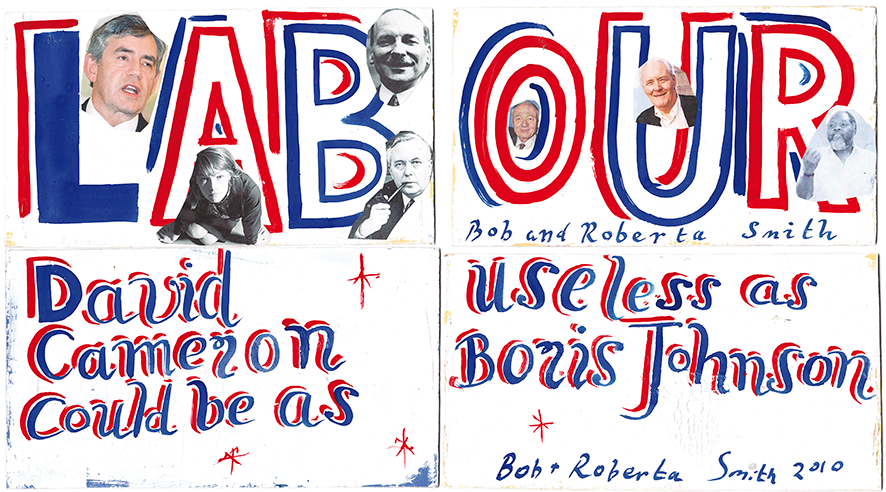
The most successful poster on makeamark.org, unique enough to have wider public recognition and appeal, was by Bob and Roberta smith [Fig 4]. Its freehand feel suggests a page in a scrapbook devoted to ones heroes. This linked with a biting message somehow manages to combine positive and negative sentiments simultaneously. Something that intuitively feels impossible. Despite the artists hope that the image would go “viral” it’s a travesty this wasn’t displayed on billboards across London.
Several more posters where created by request for the Guardian. One of the standout pieces was by Goshka Macuga, working with Fraser Muggeridge. Their typographic piece neatly illustrated the confusion surrounding whom do we vote for when our choices seem to merge into one [Fig 5]. Their design also had a reverse side which features a quote to “…remind us about the roots of democracy” [4] according to Macuga. The obscurity and lack of context for the quote makes this design much weaker than the front. The two-sided approach was intended to treat the poster as an object rather than simply an image, but the weaker reverse and a need to display the poster a certain way ultimately means each side has to be treated as a separate image.
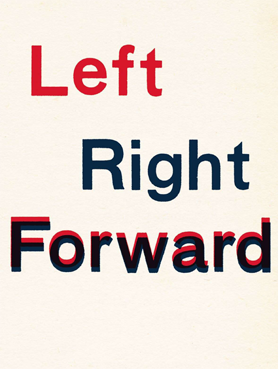
Fig 5
However the biggest problems all these alternatives to what we did see on our billboards is that they exist as downloadable PDFs from a website. The artist’s efforts condemned, in all likelihood, to being printed on bad paper using unsuitable methods at insufficient sizes by the few activist who where aware of their existence. Despite the mixed quality of the output they should have been in our public spaces, on our living room walls and on the billboards instead of another advertising inspired piece
of wallpaper.
It may be that these posters, tucked away on the web, Conservative or Labour, where ignored for wider public use because of the change in emphasis in our use of public spaces. The look and feel of political posters we were treated to is probably the result of the rise of advertising and the consumer society in the latter half of the 20th Century. It may have been the misguided fear within political parties that these images would, in fact, alienate and confuse voters. This is of course debatable, but somewhat less debatable would be their ability to turn heads for being different. That quality in itself may have been significant and getting people to engage in politics.
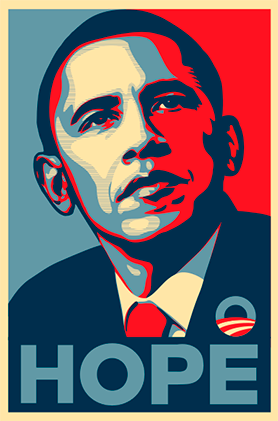
Fig 6
Clearly much of the blame for the failure of political posters must lie at the feet of our politicians and the messages they want communicating. Their reticence to describe their politics in terms of ideology affects their ability to communicate the ideals they want to achieve. But as an advocate of the democratic process and a graphic designer I believe a change of approach to the posters we are creating in this country and not just the politicians we are electing would be a small but positive step forward. An engagement by graphic designers in the process of communicating the message might just make the message being communicated a better one.
Shepard Fairey’s ‘Hope’ poster of Barack Obama [Fig 6], an image already absorbed into mainstream culture, shows there are designers who are willing to get involved with conventional politics despite having counter-cultural allegiance. The Hope posters success demonstrates to graphic designers in the UK that they need to assert a role in the political mainstream of this country and provide an alternative to the status quo.
Those designers with a strong political mindset, certainly those who identify with the First Things First Manifesto 2000 should see the state of our political posters as an opportunity. In an article [5] for Eye Noel Douglas restates the philosophy of the manifesto well:
“Graphic communication cannot be limited to the process of selling commodities, it is a powerful tool for both re-imagining the world, and expressing the truth of our situation.”
Despite his call to arms being for more radical engagement I would be happy to simply see graphic designers, shake off their cynicism, and lend their not inconsiderable talents to help political
parties large and small alike and in the process potentially become a much more effective part of the
change they crave. Designers who have political convictions owe it to the electorate to help illustrate in creative, striking fashion the politics, values and philosophies of the political parties they are
aligned with.
The change I want to see is a new generation of political posters - that reflect the talents of graphic designers - on bus shelters, at railway and tube stations and not just on advertising hoardings. I want this to go hand in hand with a change to more meaningful political messages. I vote for change, who’s with me?